TLDR
Most AI support is built around deflection, but that breaks down when customers need help actually completing tasks, not just finding answers.
For the past few years, AI in customer support has been defined by one goal: deflection.
- Reduce ticket volume.
- Lower cost per interaction.
- Keep customers away from human agents.
On paper, it makes sense. But in practice, it creates a tradeoff most organizations are now feeling: Lower cost often comes at the expense of customer experience.
Customers are not trying to avoid support. They are trying to get something done. And when AI fails to help them complete that task, they don’t disappear. They escalate, repeat the issue, or abandon the experience altogether.
The next phase of AI support is not about deflection. It is about resolution.
Deflection Solves the Wrong Problem
Deflection assumes that most support issues are simple.
It assumes the answer already exists in a help center article or FAQ. It assumes that if you present the right piece of content, the customer can figure it out on their own.
But that is not how most digital experiences actually work.
Modern customer journeys are:
- Multi-step
- Highly contextual
- Often spread across web and mobile applications
Customers are not looking for answers. They are trying to:
-
Log into an account across multiple systems
-
Complete a payment or transaction
-
Navigate onboarding flows
-
Fix something that is not working as expected
These are not knowledge problems. They are execution problems.
And execution problems are where deflection breaks down.

Why Today’s AI Support Falls Short
Large language models have dramatically improved how companies handle support conversations.
But most AI support tools still operate with a critical limitation:
They rely on text, not context.
They cannot see:
- Where the user is in the application
- What actions they have taken
- What is actually causing friction
This leads to familiar experiences:
- Generic responses that don’t match the situation
- Repeated instructions that don’t resolve the issue
- Endless loops that eventually lead to escalation
In this model, AI becomes a system of response, not a system of understanding.
And without understanding, true resolution is not possible.
Resolution Requires Real-Time Understanding
To move beyond deflection, AI needs to do more than retrieve answers.
It needs to understand the live state of the user experience.
That means:
- Knowing exactly where the user is in a workflow
- Seeing what has already been attempted
- Identifying where the breakdown is happening
This is the gap between what AI promises and what it actually delivers today.
Most AI strategies stop at knowledge.
Very few extend into experience.
The Missing Layer: Co-Browsing and Visual Context
This is where co-browsing changes the equation.
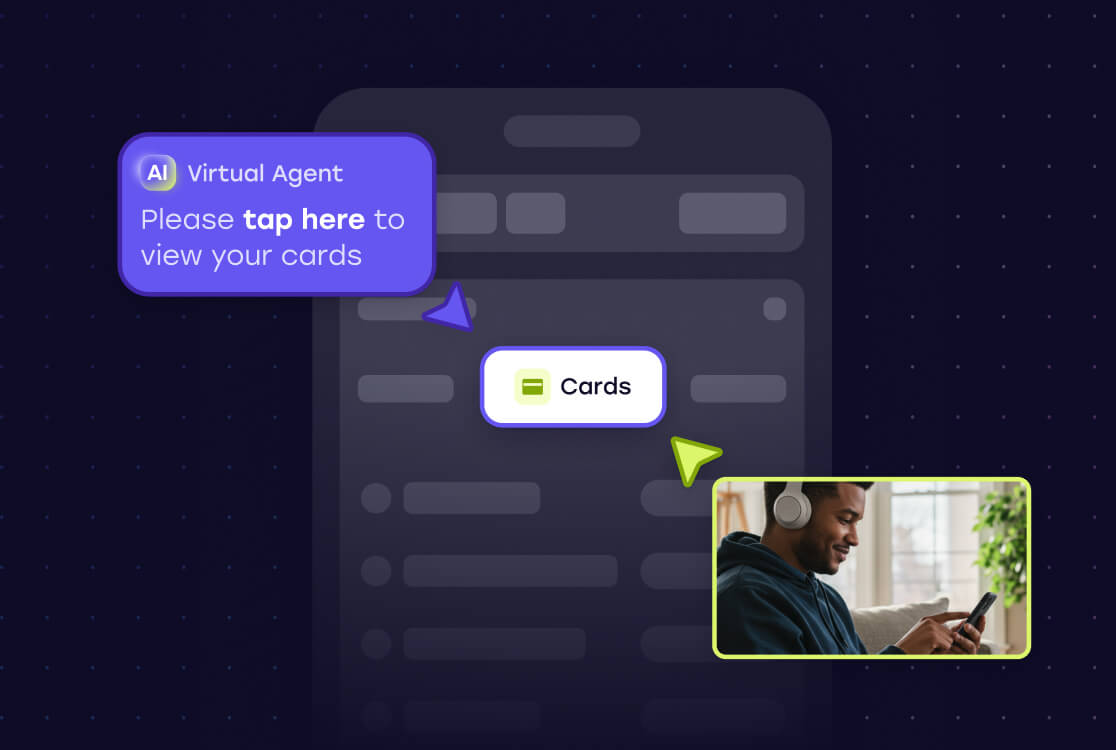
Co-browsing technology allows support agents, and now AI, to see exactly what the user sees in real time. Instead of relying on descriptions, guesswork, or static knowledge, support becomes grounded in the actual customer experience.
With co-browsing, AI can:
- Understand where a user is stuck within a web or mobile application
- Guide them step by step through a process
- Validate actions as they happen
- Deliver precise, situation-aware support
This transforms AI from a passive responder into an active participant in problem solving.
Instead of saying “here’s what to do,” AI can effectively say,
“I see what’s happening. Let me guide you through it.”
From Deflection to Resolution
The difference between deflection and resolution is simple, but important.
Deflection:
- Redirects the user
- Surfaces content
- Reduces ticket volume
Resolution:
- Completes the task
- Solves the problem
- Builds user confidence
When organizations focus on resolution, the impact shows up across key metrics:
- Higher first contact resolution (FCR)
- Lower average handle time (AHT)
- Improved customer satisfaction (CSAT)
- Fewer repeat contacts
- Stronger digital adoption
Co-browsing plays a critical role in this shift by enabling real-time, guided support instead of static, one-size-fits-all answers.
What Resolution Looks Like in Practice
Consider a few common support scenarios:
Feature Access Issue (Role / Permissions Based)
A user is trying to access a feature or complete an action, but the option is missing or disabled.
- Deflection: send a generic article explaining where the feature should be located
- Resolution: recognize that the feature is not visible due to that user’s specific role, plan, or account configuration, explain why it is unavailable, and guide them through the correct next step, whether that is requesting access, switching accounts, or upgrading their plan
Document Upload Failures
A customer is trying to upload verification documents but keeps failing.
- Deflection: provide file format and size guidelines
- Resolution: see the upload error, explain what’s wrong, and guide them to successfully complete the upload
Billing Question (Month-over-Month Change)
A customer asks why their bill changed from the previous month.
- Deflection: provide a direct explanation of the likely cause and link to a billing FAQ or statement breakdown
- Resolution: guide the customer through their billing section in real time, show them exactly where to view charges and usage, and introduce any new features or tools that help them understand and track changes on their own moving forward
In each case, co-browsing enables support that is grounded in the customer’s actual experience.
Instead of generic answers, support becomes:
- Contextual, based on what the user is seeing in that moment
- Interactive, guiding them step by step through the workflow
- Outcome-focused, ensuring the task is completed and understood

The Future of AI-Powered Customer Support
As AI continues to evolve, its role in customer support will expand.
AI will not just triage issues. It will become the first line of resolution.
Human agents will still play a critical role, but their focus will shift toward:
- Complex edge cases
- High-value interactions
- Relationship-driven support
AI, powered by technologies like co-browsing, will handle the majority of interactions with accuracy and consistency.
This is not just about automation. It is about building a scalable, high-quality support experience.
Resolution Is the New Standard
Customers do not measure success by whether their issue was deflected.
They measure it by whether their problem was solved.
Organizations that continue to optimize for deflection will see diminishing returns.
Those that invest in resolution will:
- Reduce costs without sacrificing experience
- Improve efficiency across support operations
- Empower customers to succeed within digital channels
Co-browsing is a key part of that transformation, providing the real-time visibility and guidance needed to turn AI into a true resolution engine.
The future of customer support is not about avoiding interactions.
It is about making every interaction count.
Read more on this
The Future of Enterprise AI Is Built on Understanding