TLDR
Most enterprise AI today helps agents work faster. The next shift is AI that directly supports customers. Companies that build the right foundation and solve AI’s visibility gap will be the ones that scale smarter support.
Enterprise AI strategy is evolving quickly.
Right now, most organizations are focused on using AI to improve internal operations. Tools like AI agent assist, copilots, and knowledge automation are helping support teams work faster and handle more complex customer interactions.
But this is just the first phase.
The future of enterprise AI is customer-facing. AI that doesn’t just support agents, but directly interacts with customers to guide, resolve, and complete tasks in real time.
To get there, companies need more than better models. They need the right foundation.
Phase 1: AI for Agent Productivity
Today’s enterprise AI investments are centered around internal efficiency.
Common focus areas include:
- AI-powered knowledge bases and search
- Automated response generation
- Intent detection and response interpretation
- Workflow automation for support teams
- AI generated summaries and case notes
These tools are improving key contact center metrics like AHT, FCR, and CSAT by helping agents respond faster and more accurately.
But more importantly, they are creating the infrastructure needed for the next phase of AI.
Because effective customer-facing AI depends on the quality of the systems being built today.

Phase 2: Customer-Facing AI and Autonomous Support
The next evolution of enterprise AI is external.
Customer-facing AI will act as the first line of support, handling interactions directly with users across web and mobile experiences.
This includes:
- AI-powered chat and voice agents
- Real-time digital guidance within applications
- Automated issue resolution without human intervention
This shift enables companies to scale support operations without increasing headcount while delivering faster, always-on customer experiences.
But this level of automation requires a much deeper level of accuracy and understanding.

Why Phase 1 Is Critical for Phase 2
Customer-facing AI is only as effective as the data and workflows behind it.
To move from agent assist to autonomous AI support, organizations need:
- Accessible knowledge systems
- Clean, structured, and continuously updated data
- Accurate intent recognition and response logic
- Clearly defined resolution paths for common issues
Just as important is the feedback loop.
Every customer interaction handled by an agent today provides valuable training data for AI.
Where do users get stuck?
What actions lead to resolution?
What guidance actually works?
Organizations that capture and operationalize this data will be able to train AI systems that perform reliably in real-world scenarios.
Those that don’t will struggle to move beyond basic automation.
The Role of Trust in Enterprise AI Adoption
Despite the momentum, most companies are not rushing into fully autonomous AI.
The primary reason is trust.
Internal stakeholders need confidence that AI can deliver consistent and accurate outcomes before expanding its role.
Customers also need to trust that AI interactions will be helpful, not frustrating.
If AI provides incorrect guidance or fails to resolve issues, it creates friction and erodes confidence quickly.
This is why many organizations are taking a phased approach. They validate AI performance internally before exposing it directly to customers.
Trust is not built through experimentation alone. It is built through consistent, accurate outcomes at scale.
The Visibility Gap in AI-Powered Customer Support
One of the biggest limitations in both phases of enterprise AI is lack of visibility.
In traditional support interactions, agents rely on customer descriptions to understand issues. This often leads to miscommunication and longer resolution times.
AI faces the same challenge, but at scale.
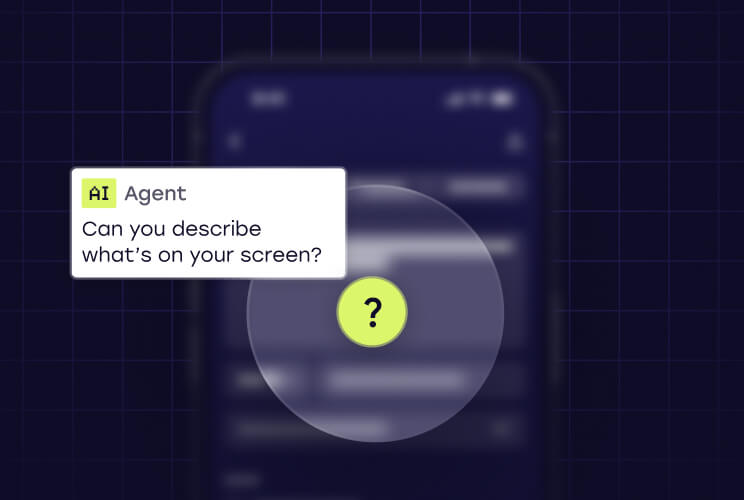
Most AI systems can process language, search knowledge bases, and generate responses, but they cannot actually see the digital experience in front of the user. They do not understand where a customer is, what they are trying to do, what actions they have already taken, or where friction is occurring.
Without that context, AI operates like a lookup tool. It can retrieve answers, but it cannot deliver truly situational guidance.
This limits its ability to resolve complex issues accurately and confidently.
Closing this visibility gap is essential for both agent assist and customer facing AI strategies.
How Cobrowse Improves Agent Assist in Phase 1
Cobrowse enhances AI-powered customer support by giving agents real-time visibility into the user’s experience.
Instead of relying on descriptions, agents can see exactly what the customer sees within a web or mobile application.
This leads to:
-
Faster issue identification and resolution
-
Improved first contact resolution
-
More effective digital guidance for users
Beyond operational improvements, Cobrowse also generates high-quality interaction data.
It captures how users navigate applications, where friction occurs, and how issues are resolved.
This data is critical for training AI systems that can replicate successful outcomes.
How Cobrowse AI Enables Customer-Facing AI in Phase 2
As organizations move toward customer-facing AI, visibility becomes even more important.
Cobrowse AI provides AI agents with real-time visual context of the user experience.
This allows AI to:
-
See where the customer is in real time
-
Understand configurations, inputs, and on screen errors
-
Understand the application live without relying on static documentation
-
Deliver precise step by step guidance based on real context
Instead of generic responses, AI becomes capable of resolving complex issues with accuracy and confidence.
This transforms AI from a support tool into a true service channel.
Building a Scalable Enterprise AI Strategy
The transition from agent assist to customer-facing AI is not a single step. It is a progression.
Organizations that succeed will focus on:
- Building strong data and knowledge foundations
- Creating feedback loops between agents and AI systems
- Establishing trust through consistent performance
- Closing the visibility gap in customer interactions
Enterprise AI is not just about automation. It is about understanding.
And without visibility, understanding is limited.
Cobrowse AI provides that missing layer, enabling both agents and AI to operate with real-time context.
That is what turns AI strategy into real-world impact.
Read more on this
The Future of Enterprise AI Is Built on Understanding